
Research: what 6 years of chart setups show
Over 8,000 rule-based chart setups since 2020, traded the way a reader could have: what wins, what loses, and what changed in the letter.
Before the letter changes a rule, we test it on history. This page shows what that testing found, in plain numbers.
The test: about 2,000 US stocks, October 2020 to June 2026. Every setup the letter's rules would have found, over 8,000 in all: breakouts over a prior high, inverse head and shoulders, rectangles, ascending triangles and double bottoms. Each one was traded the way a reader could have traded it: bought at the next open after a close over the trigger, stop by the Last Day Rule, initial stop held until the trade closed 2R in profit, then a trailing stop 3 daily ATRs under the high.
See the full tables
This page shows the headline findings. Paid members get every table behind them:
- Results for each pattern and each year since 2020
- Four stop rules side by side
- Entry timing: daily vs weekly close, buying the open, re-tests
- The SPY, trend score, volume and risk tables
- How trades end, and the range of results over 100 setups
Already a paid member? Sign in to open them.
Most setups lose, and that is normal
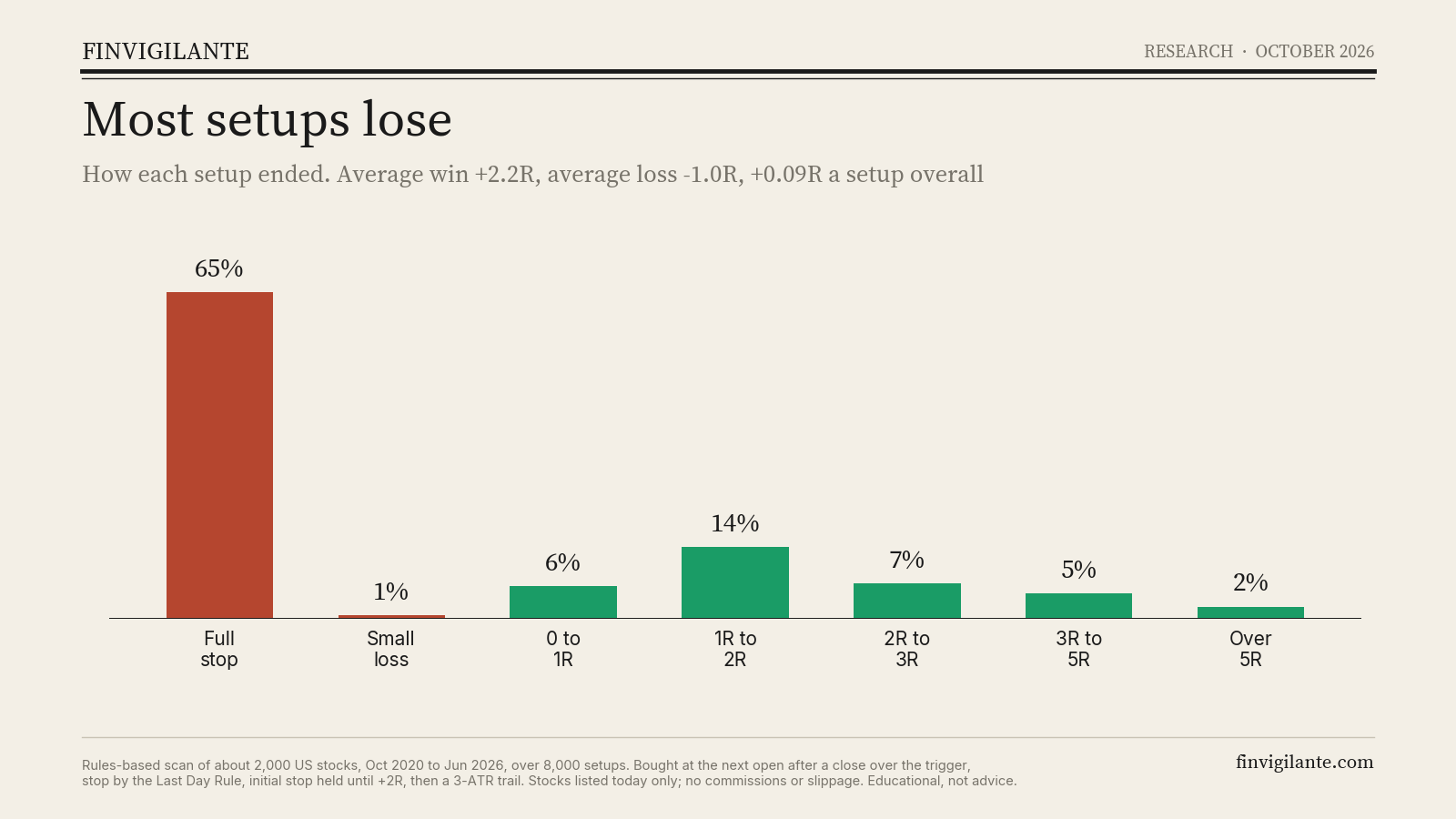
About 65% of setups ended at the full stop. The method still came out ahead because the winners were bigger than the losers: the average win was +2.2R, the average loss -1.0R. Across every setup that came to +0.09R a setup. With the letter's filters (below) it was +0.14R.
Being wrong most of the time is the normal case for breakout trading, not a sign the method is broken. The edge is in the size of the few that keep going.
Where SPY sits matters
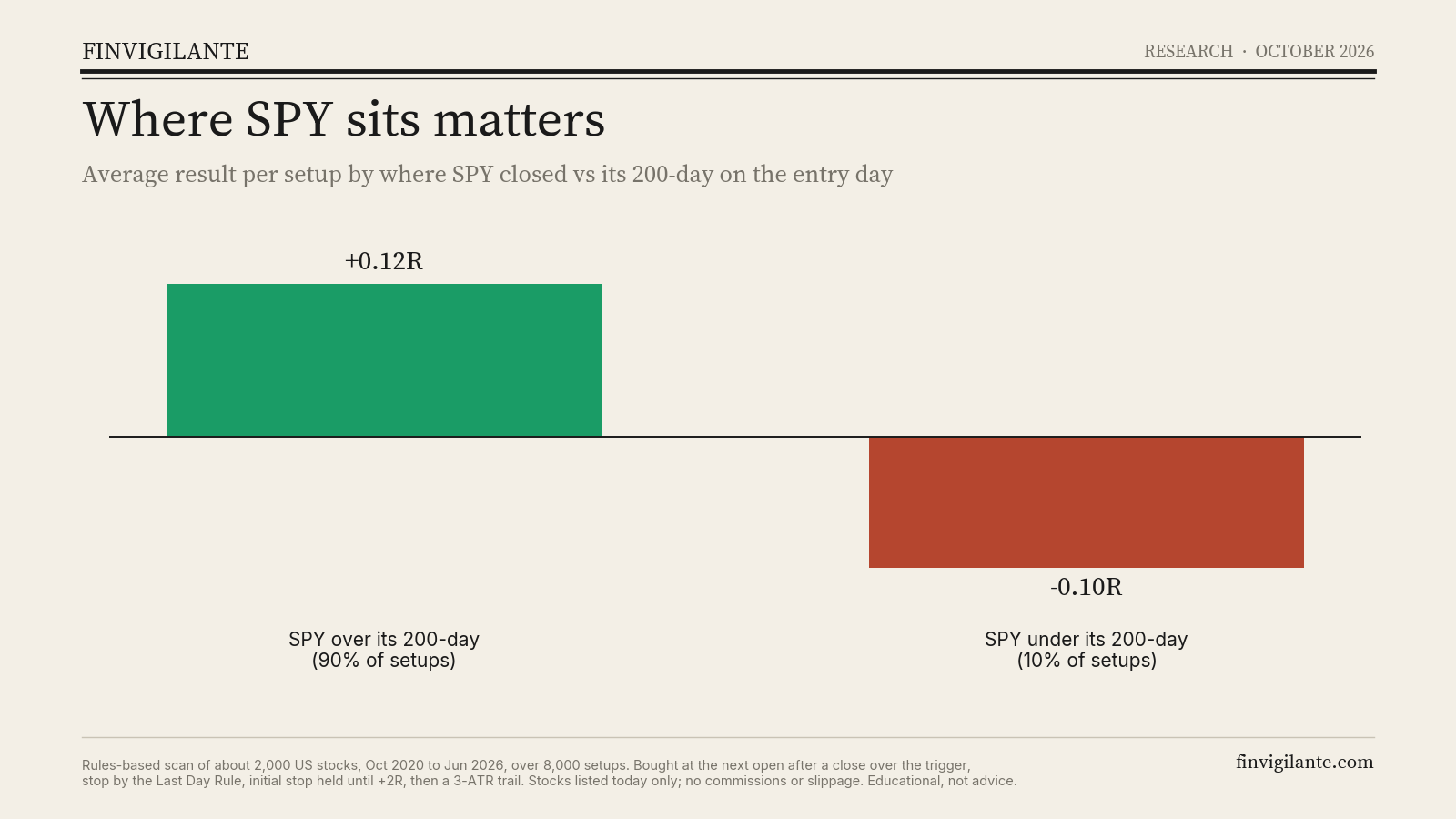
Long setups taken while SPY closed over its 200-day average made +0.12R a setup. Taken while SPY was under it, they lost -0.10R a setup. It was the clearest single filter we tested, and it held in both halves of the period. The letter lists no new setups while SPY closes under its 200-day.
Breakeven stops cost money
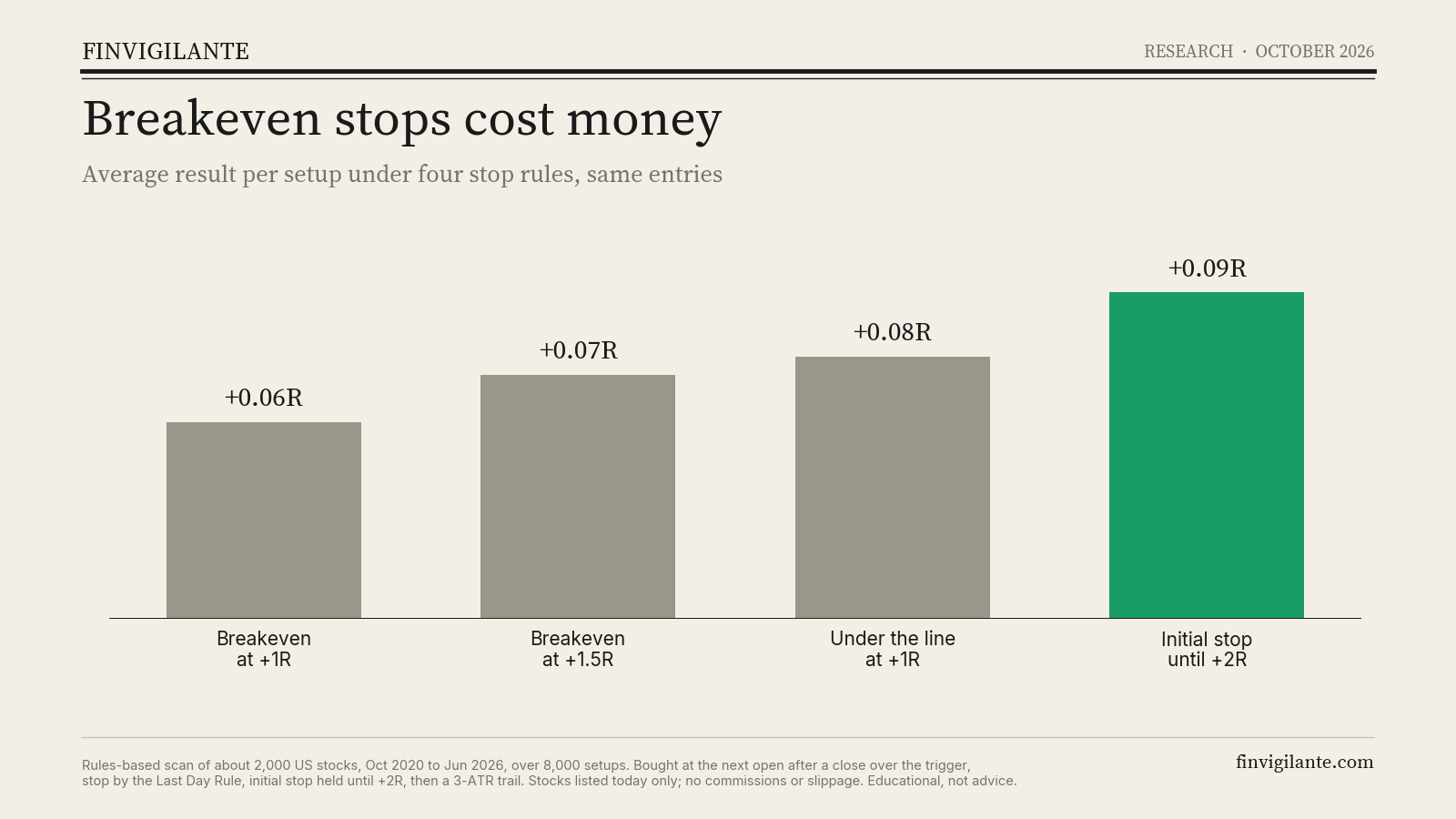
Moving the stop to breakeven once a trade is 1R in profit feels safe. In the test it was the worst of four stop rules: +0.06R a setup, against +0.09R for leaving the initial stop alone until +2R. Many breakouts come back to retest the line before they run, and a breakeven stop sits right there. The letter's stop rule: initial stop until +2R, then trail.
How far setups go
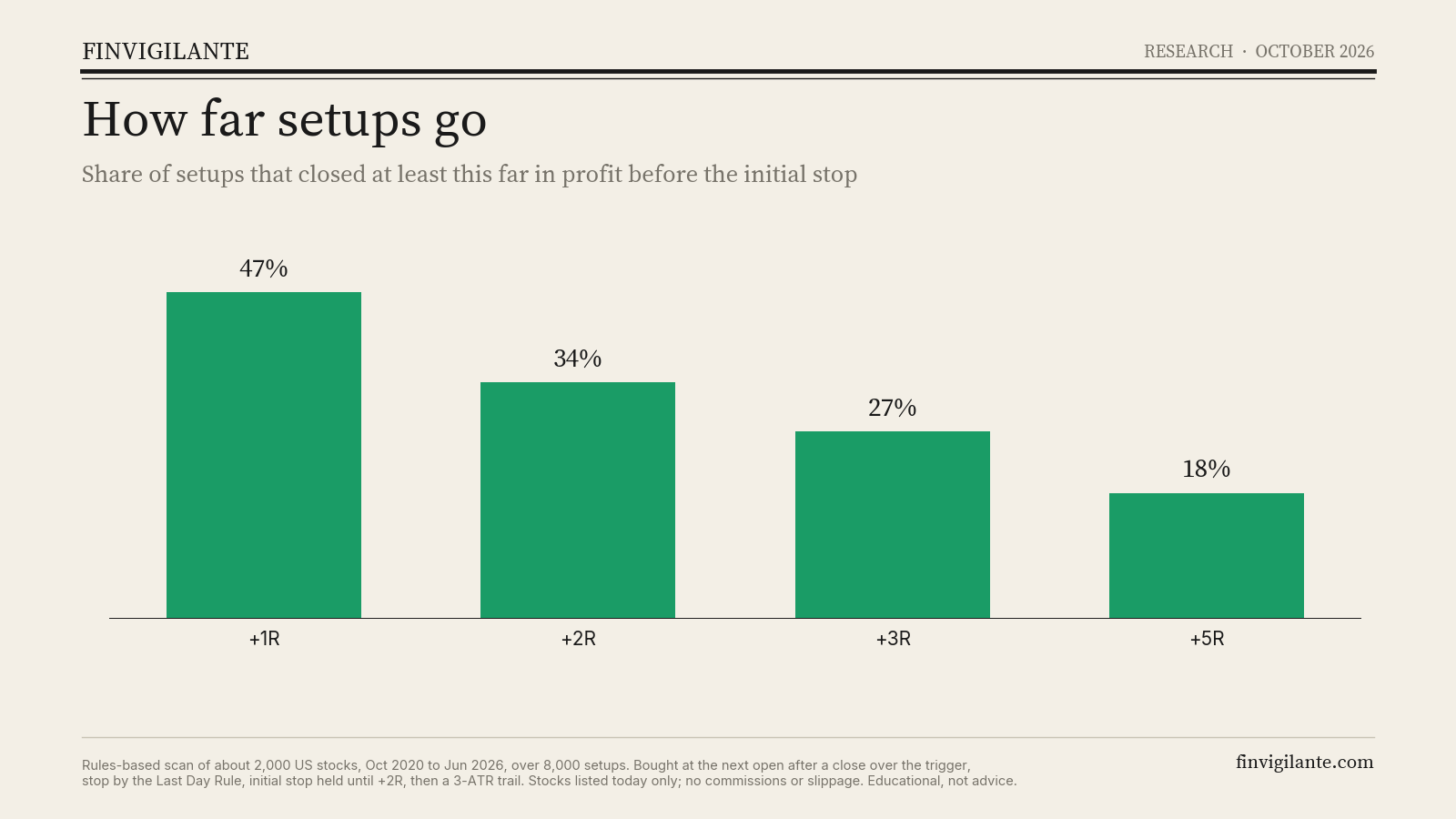
47% of setups closed at least 1R in profit at some point, 34% reached 2R, 27% reached 3R and 18% reached 5R. Most of the result comes from that last group.
What changed in the letter because of this
- No new setups while SPY closes under its 200-day average. Open setups are still tracked.
- A new name must meet at least 2 of 5 basic trend conditions. Names meeting fewer lost money as setups.
- No new double bottoms. They lost money on average in the test.
- The initial stop holds until +2R; there is no move to breakeven.
What this test is not
- It is a backtest, not a record of real trades. The results are hypothetical, and past results do not predict future ones.
- It only includes stocks listed today. Companies that failed or were delisted are missing, which makes the results look better than real life.
- It ignores commissions, slippage and taxes.
- It counts every setup. Many overlap in time, and no real account could take them all.
- Some filters were found on this same data, so their effect may be smaller going forward.
The numbers are re-run when the rules change. Last updated October 17, 2026. Educational, not investment advice. See the disclaimer.
Want the detail behind these numbers?
Paid members get the full research tables, plus the nightly list of setups with exact levels.