
Free course, lesson 2: The trigger and the stop
Why a setup confirms only on a daily close, and how Peter Brandt's Last Day Rule sets the stop from the chart.
Free course · Lesson 2 of 5
A setup confirms on a close, not a touch. The trigger sits a little past the line: half of the stock's average daily range (ATR) beyond it. Only a daily close at or past the trigger counts. A stock that pokes through at noon and falls back by 4pm has not confirmed.
Why a buffer? Many breakouts briefly cross the line and fail. Asking for a close a bit past it filters out some of those false starts.
The stop comes from the chart, not from a percent. It uses Peter Brandt's Last Day Rule: find the last full day whose whole bar sat inside the pattern before the breakout. The stop goes just under that day's low. If price closes back under it, the breakout has failed by its own structure.
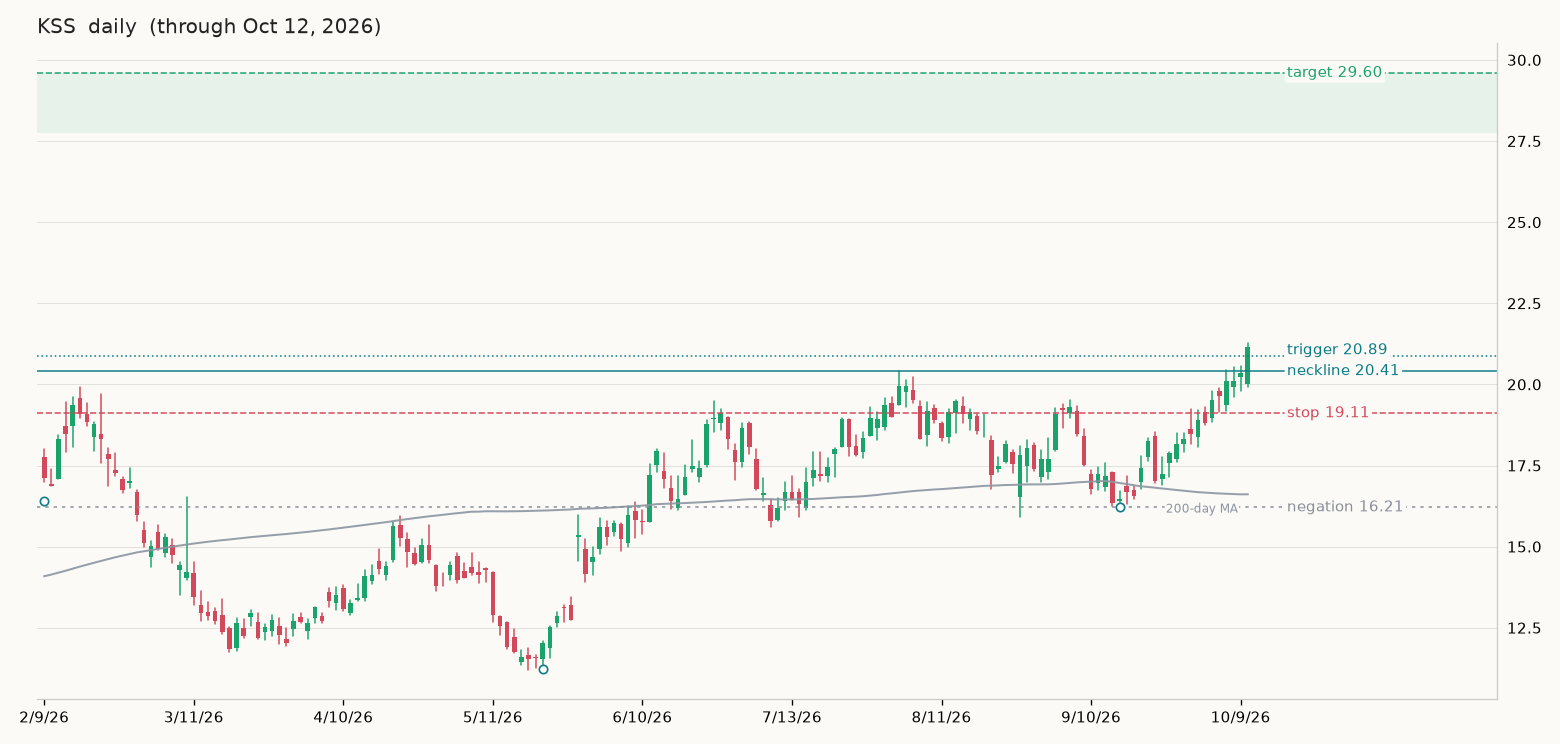
Two things follow from that:
- There is no stop before the breakout. Until then a pattern can only fail on its structure, for example a rectangle closing under its floor.
- The stop is wherever the chart puts it. A wide stop is not trimmed to look tidy; it just means fewer shares, which Lesson 3 covers.
The distance from the trigger to the stop is the setup's risk, called 1R.
Quick check
A stock trades above its trigger at noon, then closes under it. Has the setup confirmed?
Where does the Last Day Rule put the stop?
Go deeper: The Last Day Rule
Educational content about how FinVigilante's rules work. Not a recommendation to buy or sell anything, and not tailored to you.